 Grey Villet, photographer. North Dakota Farmers Randy and Lois Oster Speak with Lawyer Activist Sarah Vogel on Their Farm, Which Faces Foreclosure. Outside Wing (Burleigh County) North Dakota. October 1982. LIFE on Google. [The Osters were later evicted from their property and pursued legal proceedings against their bank and then the federal government].
In 1986, Frank and Deborah Popper postulated a Buffalo Commons for rethinking land use in the Great Plains. They suggested that the federal governent's intervention could save the declining region by recasting it as an enormous park, the nation's largest historic preservation project. They have recently enlarged on their original ideas as Buffalo Commons Two, emphasizing that "sustainable land use must support a wider mosaic, spanning a continuum from wilderness to agriculture to urban, of land uses ecologically well-grounded"(Popper and Popper, 2008). Stressing sufficiency and flexibility over excess and uniformity, the Poppers have adopted concepts from economists Ernst Schumacher and Herman Daly and agriculturalists Wendell Barry and Wes Jackson to emphasize ecological restoration and non-market-driven social services. They are currently working on Buffalo Commons Three.
Recently, the
New York Times reported that the state of North Dakota, unlike the rest of the country, is experiencing an
embarrassment of riches, contemplating what to do with a $1.2 billion budget surplus. The state currently has 13,000 unfilled jobs and not enough job seekers to fill them. One lifelong resident was quoted as saying, “prudence is important at this point . . . North Dakota never gets as good as the rest of the country or as bad as the rest of the country, and that’s fine with us.” To read more, click
here.
Want to read more?
Popper, Deborah and Frank Popper. "The Great Plains: From Dust to Dust" Planning Magazine (1987).
_________. "The Buffalo Commons: Metaphor as Method" Geographical Review 89:4 (1999): 491-521.
_________. "The Onset of the Buffalo Commons" Journal of the West 45:2 (2006): 29-34.
_________. "Looking Forward: Adding the Buffalo Commons to the Grasslands Mix." 31 October 2008.
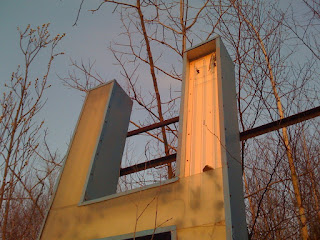 UW-Madison geographer Chris Limburg recently sent notice about compelling photographs of a neglected Spanish colonial mansion in California. The photographs were taken by urban explorer Jonathan Haeber, who has been trying to document abandoned structures along the West Coast. Haeber's Bearings group has been the subject of international news stories on contemporary urban explorers, a fanzine-originated phenonomen that has grown in popularity along with interactive web technologies. One of my favorite New Orleans urban decay images was uploaded last year by flickr user vectorsnob.

