Showing posts with label Third District. Show all posts

Friday, November 14, 2014

Edgewood Park

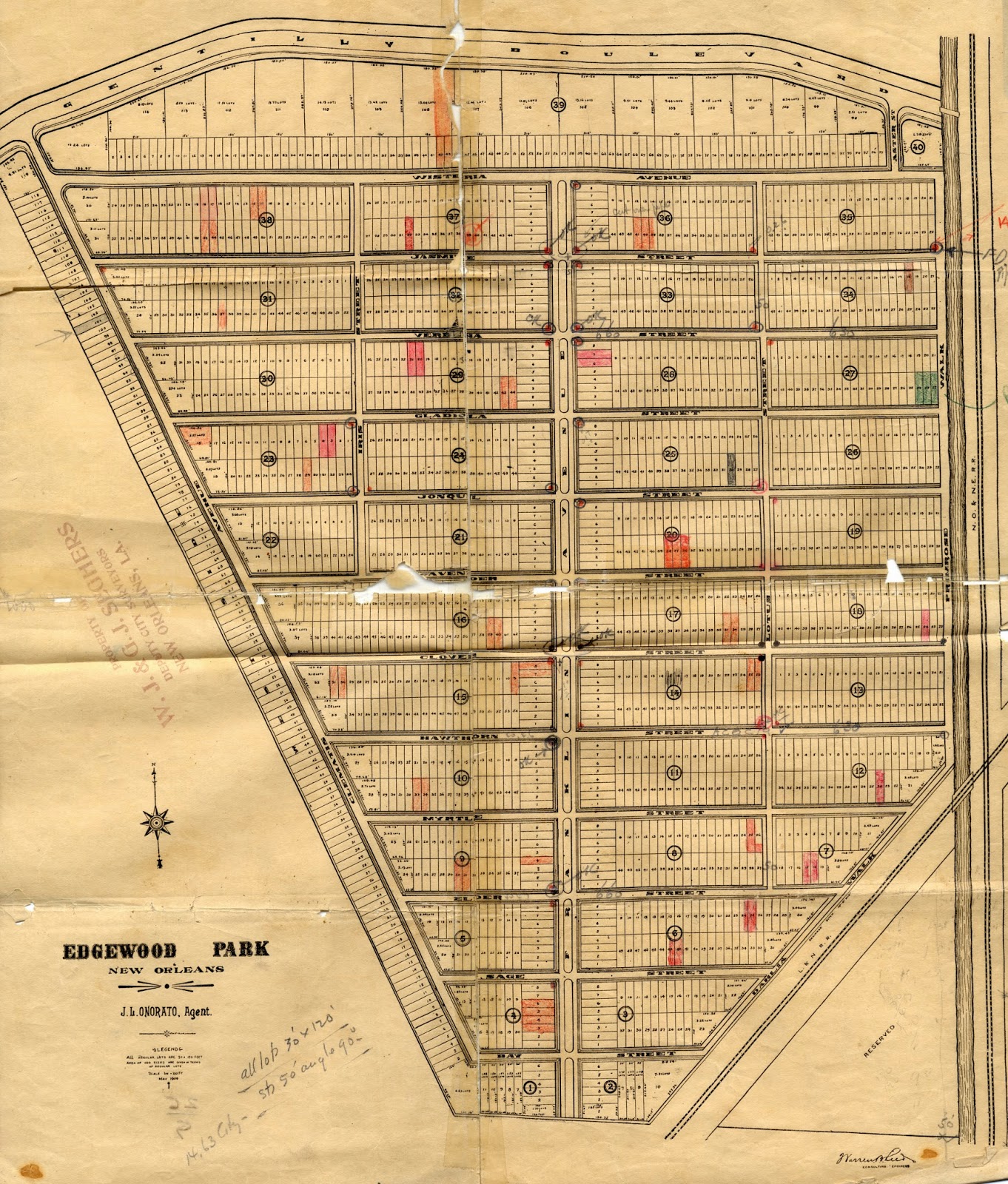
This fall the National Park Service approved New Orleans' Edgewood Park neighborhood's inclusion on the National Register of Historic Places. The subdivision was developed in 1909 on the former Dennis Sheen Tract, originally bounded by the Louisville & Nashville Railroad, the New Orleans and Northeastern Railroad, Gentilly Boulevard and Clematis Avenue. This tract was desirable pasture land covered in blackberry bushes and grass, located along a natural ridge. Real estate developer J.L. Onorato secured an option on the property in February 1909. The following month, the New Orleans Railway Company announced it would extend its Villere streetcar line a mile beyond the Franklin Avenue/Galvez Street stop in order to provide service. Soon thereafter, consulting engineer Warren B. Reed platted the subdivision with all lots measuring 30' x 120'.  Early purchasers had a tendency to buy two adjacent lots (map above). By spring of 1910, Onorato sold a large number of Edgewood's remaining lots to Grover & Leyman, an Indianapolis-based real estate investment firm.

The neighborhood includes a large number of bungalows.

Image above: William Reed, consulting engineer. Edgewood Park, New Orleans. /J.L. Onorato, Agent. May 1909. Guy Seghers Office Records, Southeastern Architectural Archive, Special Collections Division, Tulane University Libraries.

Tuesday, September 30, 2014

Shell Roads & Edgelake Lands

We had posted William E. Boesch's 1926 Map of Orleans and St. Bernard Parishes Showing Lake Shore Developments & Etc. (detail top image) some time ago, and recently came across contemporary photographs of the Edgelake Subdivision in an advertising brochure.

The Southeastern Architectural Archive's Guy Seghers Office Records contain significant documentation of the Edgelake land holdings, as the Seghers family platted many of the associated neighborhoods. The developers chose reef shell for the subdivision's primary roads, including its park entrance (second image) and Curran Boulevard (bottom image). The Gulf Crushing Company, Inc. of New Orleans supplied the oyster shells.  During the 1920s, Louisiana's road builders had difficulty forming and maintaining roadways using local clay-sand. It often failed to bond with gravel. The Old Spanish Trail was particularly susceptible to such road failures, and much of it had to be resurfaced with reef shell.

The shell was less expensive, and could also be used in emergencies to provide a safe path on flooded roadbeds. The shells required no binding agent, were durable, water resistant and provided traction.

Images above:

Map: Wm. E. Boesch, Map of Orleans & St. Bernard Parishes Showing Lake Shore Developments & Etc. Copyrighted November 1926 by Wm. E. Boesch.  Guy Seghers Office Records, Southeastern Architectural Archive, Special Collections Division, Tulane University Libraries.

Photographs from:  Shell Roads in Louisiana. New Orleans: Gulf Crushing Company, 1927. Louisiana Research Collection, Special Collections Division, Tulane University Libraries.

Thursday, August 7, 2014

NEW! Diboll & Owen Finding Aid

The Southeastern Architectural Archive (SEAA) recently finalized the processing of the Diboll and Owen Office Records. The collection provides a limited view of the firm’s architectural output, dating from 1906-1972.

The most comprehensive records are associated with the firm’s work on the Milne Municipal Boys’ Home, located in the Third Municipal District (1932-1935). These include project drawings and progress photographs, correspondence, field notes and contract documents.

Across the collection’s renderings, those associated with Jack J.H. Kessels’ work on public housing projects during the 1930s are the most complete. Other drawings mostly pertain to early projects singularly developed by Owen or in partnership with Diboll and/or Goldstein; one represents Collins C. Diboll, Jr.’s Teche Greyhound Bus Depot in collaboration with Jack J.H. Kessels and Henry Boettner.

Photographic documentation of the firm’s early buildings is significant, as the firm retained the services of the city’s leading professional photographers, John Norris Teunisson, Joseph Schnetzer, Charles L. Franck and Louis T. Fritch.


Image above: Joseph Schnetzer, photographer for Diboll and Owen, Ltd. & T.A. Pittman, Inc. Milne Municipal Boys’ Home. 1 March 1933. Progress photograph. Diboll & Owen Office Records, Southeastern Architectural Archive, Special Collections Division, Tulane University Libraries.

Wednesday, June 27, 2012

Antebellum Garden 1858


As reported by The New Orleans Daily Crescent 25 April 1858:

A Model Home.-- The larger number of our wealthy citizens consider a three or two story house, fronting abruptly upon the well-traveled pavements, which line some noisy and dusty, but fashionable street the extreme of all reasonable ambition for the possession of home or property. Well, the three or two story house opening immediately upon the pavement of some fashionable street, looks grand. Is it as entirely comfortable as other localities which might be chosen in the vicinity of the city?

If any had joined us in a pleasant ramble on last Saturday evening, as far as Desirée street, in the Third District, he might have thought differently. Fronting on that street and running from Greatmen to Levee, is the home of Mr. Lawrence, a gentleman, who, though actively engaged in business, operating in cotton and sugar, yet cultivates the nice and refined tasted of the accomplished horticulturalist.

Over his neat cottage home, sweeps the cool breeze, which has daintily kissed the waves of the river which sweeps by our city, and which, from his tressiled [sic] and flower-embowered porch, refreshes the eye and forehead of one wearied with summer heat. In his cool and quiet parlors, so hushed and shaded that one listens with almost painful suspense, for the cricket's chirrup, works of art from the painter's easel and the engraver's labor, so calm and so lifelike, that you almost realize in them an active presence meeting the eye. Among the paintings are some very excellent ones, the work of Mr. L.'s accomplished lady.

One wanders into his gardens, and the first thing which catches the eye is the princely amaryllis. It is a royal flower, and flaunts itself bravely in the garish day. It steals its livery of bright hues from the sun, and looks all splendor. There is the heliotrope, the jessamine, the honeysuckle, the white rose, but we have no space to enumerate.

We pass to the useful. Corn from Tehuantepec seed; melons from African, French and English seed; nectarines, figs, pomegranates, artichokes, Falstaff raspberries, Crescent strawberries, yielding six months in the year, oranges, lemons, giant quinces, grafted and growing in the same tree, fig-trees thriving lustily, banana plants growing well, pine-apple plants in numbers beyond all our previous ideas of their cultivation in New Orleans, showing every promise of successful growth, and other things too numerous to mention, attract the eye, charm the senses and awaken attention.