Showing posts with label St. Charles Avenue. Show all posts

Tuesday, December 15, 2015

OST Hot Spots

Since I attended the Old Spanish Trail Centennial Celebration in Mobile, Alabama last week, I've been thinking about how the Good Roads Movement affected commercial architecture. Tracking down relevant structures requires mapping OST road beds and cross-checking Sanborn data sets, building plans and historic newspaper accounts.

The route -- highlighted above -- took westbound travelers through the Crescent City along Bayou Sauvage/Gentilly Road to North Broad  (via Paris) on to Canal, St. Charles, Broadway and ultimately to the Westwego-Walnut Street ferry.(1)

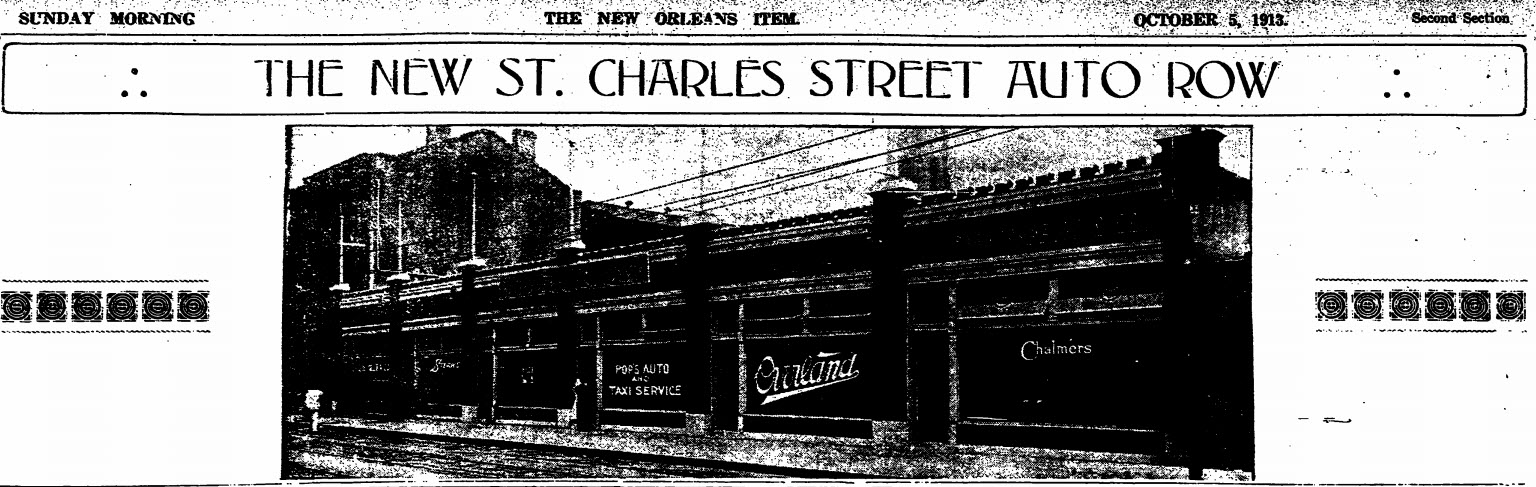
A St. Charles Street "Automobile Row" began to emerge in 1913. Various developers acquired historic residences along the artery between Girod and Julia Streets, and either adapted them or razed them for other use. Julius Koch was awarded a contract to demolish a boarding house and construct a 131' foot showroom (preliminary rendering above; photograph below). Three years later, Koch also designed a new building for the Firestone Tire and Rubber Company.(2)
Not all of the structures listed below are still standing, but most of them are. Some of them feature ornamental automobile symbolism such as wheels and wings.

If you are interested in learning more about the OST Centennial and/or wish to become involved in the planning process, click here.

St. Charles Avenue

1400

M.G. Bernin Motor Trucks (1919)

1423

Motor Car Service Company, Inc. (1920)

1701-11

Abbott Motor Company {Two buildings -- Packard Showroom & Apartments/Showrooms} (1920)

1820 

Packard New Orleans Company (1929)


2001 

Abbott Automobile Company (1920)


St. Charles Street


700

Fairchild Motor Car Company (1917)

706

Woodring-Hamilton Car Company (1916)

714

Ellis Motor Company [formerly King Motor Company] (1920)

721

United Motor Car Company (1920)

726

Safety Tire Repair Company (1916)

728

Hotel Orleans (altered for this use in 1917-1918)

734

Demack Motor Car Company (1918)

735

Herbert E. Woodward Tires (1915)

741

Capital City Auto Company (1915)

742

Moon Agency (1914)

749

L.A.M. Motor Company (1918)

750

B.F. Goodrich Company New Orleans Branch (1914)

752

Abbott Auto Company "Used Car" Department (1919)

759

Stoutz Motor Car Company (1917)

760-762

Willys-Overland Company (1914)

Firestone Tire and Rubber Company (1916)

Freeport & Mexican Fuel Oil Company (1917)

829 

Capital City Auto Company (1919)


And others that were very near to the OST:

Baronne Street

601-603

Charles E. Miller New Orleans Branch [Automobile Sales] (1910)

615-621

Shuler Auto Supply Company Inc. (1919)

618 

M. Zilberman Show Room (1918)

702-716

Abbott Cycle Company (1906)
{They also sold automobile gloves}

Abbott Automobile Company (1908)

751-761

New Orleans Chevrolet Company (1926)

801

Brown Tube Company (1914)

Model Motor Truck Company, Inc. (1917)

821-823 

Abbott Automobile Company, Ltd. (By 1916)

840-842 

Fairchild Auto Company (1910)

Howard Avenue

822

Bernstein Glenny Motor Car Company (1917)

828-832

Lyons-Barton Motor Car Company (1915)
{Constructed using Kahn System}

Julia Street

611

B.P. Braud, Inc. Cord Tire Repairing (1920)


(1)An earlier route kept autoists on the east side of the Mississippi along the River Road.

(2)"Big Auto Tire Company to Make Crescent City Its Distributing Point." The Sunday States 21 May 1916.

Images above: Old Spanish Trail Association. Old Spanish Trail Road Map Southern Louisiana. October 1924. Louisiana Research Collection, Special Collections Division, Tulane University Libraries. Digitally enhanced.

"New Orleans to Have 'Automobile Row' by September 15." The New Orleans Item 12 June 1913.

"The New St. Charles Auto Row." The New Orleans Item 5 October 1913.

Abbott Automobile Company, 2001 St. Charles Avenue. As it appears in The New Orleans Item 12 December 1920.

Fairchild Motor Company, 700 St. Charles Street. As it appears in The New Orleans Item 8 July 1917.

Tuesday, November 10, 2015

New Orleans University (1891)

We recently came across this image of New Orleans University, a grandiose Gothic Revival building funded by the Freedmen's Aid Society of the Methodist Episcopal Church. Ground breaking ceremonies were conducted in January 1886, and the building was completed the following year. Chattanooga, Tennessee architects the Adams Brothers designed the five-story brick building with a mansard-roofed dormitory space.

The building was located at 5318-22 St. Charles Avenue, was altered when it became the Gilbert Academy, and ultimately demolished in preparation for Burk, LeBreton and Lamantia's De La Salle High School (1950).

Image above:  New Orleans University. Year Book: Eighteenth Year. New Orleans University 1890-1891. New Orleans: The University, 1891. Wood engraving. As viewed 10 November 2015 via Internet Archive.

Friday, March 14, 2014

NEW! Andrew Lockett Finding Aid

The Southeastern Architectural Archive recently finalized the processing of the Andrew M. Lockett, Jr. Office Records. The collection consists of project drawings associated with the career of Andrew Moore Lockett, Jr., an Atlanta-born architect (1896-1984) who designed the St. Charles Avenue mansion known as "Tara."

Consult the finding aid here.

Image above: Lockett and Chachere, architects. Crown Food Palace, 3955 Washington Avenue. 1928. As it appears in the Crown Food Palace Section, The Times-Picayune (9 May 1928).

Monday, February 3, 2014

Early Curtis & Davis Project

In 1950, New Orleans architects Curtis & Davis received attention from Progressive Architecture for their 1949 rehabilitation of an automobile sales and service establishment. Klein Motors, Incorporated, 832-840 St. Charles Avenue, had been largely destroyed by fire.

The owner demanded the architects reuse the three remaining masonry walls (two sides and rear) and develop a new showroom, offices and service area. The budget was limited, and Curtis & Davis integrated pilaster-supported 100-foot clear span trusses with the salvaged walls. The terracotta-colored enameled aluminum upper portion of the facade emulated a billboard and supported Klein's commercial signage. The biomorphic white tiled canopy, in-sloping showroom curtain wall and strategically placed spotlights were intended to draw attention to the automobiles. When the project was completed, the young partners hired Clarence John Laughlin (1905-1985) to take photographs for the Progressive Architecture feature.

According to Curbed New Orleans, the structure recently sold for $1.63 million and will be used to house The New Orleans Advocate.

UPDATE:  The New Orleans Advocate plans to return the facade to its C & D era form.  Read more on The New Orleans Advocate.

Read more about the C&D rehabilitation in "Automobile Sales and Services Buildings." Progressive Architecture 31 (1950): pp. 75-78.

"Formal Reopening of Firm Set Today." The Times-Picayune (1 April 1949): p. 26.

Image above: Clarence John Laughlin, photographer. Klein Motors, Inc. 832-840 St. Charles Avenue. Circa 1949. Color positive film. Curtis and Davis Office Records, Southeastern Architectural Archive, Special Collections Division, Tulane University Libraries.

Wednesday, December 4, 2013

Carrie Nation's Visit

In the winter of 1907, temperance leader Carrie Nation (1846-1911) stopped in  New Orleans on her way to winter in Guadalajara, Mexico. On December 19, she entered the St. Charles Hotel Cafe and Bar (image above) at 4:00 pm in order to condemn alcohol consumption. The Daily Picayune reported that customers responded with shouts of 'Put her out!' and 'You've got no chance in New Orleans, Carrie!'

Before reading her temperance poems, Nation berated the decor:

"Glad female figures, scantily attired, adorned the walls, and these were a special object for Carrie's comment. She 'chewed the rug plum off,' as the popular expression goes, and a number of the 200 or more men who crowded the cafe before she had finished her five-minute talk were visibly touched, although the majority were smiling and winking at the novelty of hearing a woman who was bold enough to penetrate the mysteries of the swinging screen doors at the entrance."

Thwarted by her attempts to meet the hotel-bar proprietor, Nation departed to address the Y.M.C.A.

Quoted matter from: "Carrie Nation of Saloon Smashing Fame is in Tub City." The Daily Picayune (20 December 1907): p. 11.

Image above: Gravier Street West from St. Charles. Circa 1907. Photomechanical reproduction from unidentified source. Miscellaneous Photographs Collection, Southeastern Architectural Archive, Special Collections Division, Tulane University Libraries.

Friday, August 19, 2011

Beekman's Haberdashery

We recently came across a wonderful sketch in one of the Benson & Riehl Office sketchbooks, circa 1950. It represents the facade of Beekman's Men's Clothing Store, which was located at St. Charles Avenue & Commercial Place, municipal numbers 328-330 (top image). The Beekman haberdashery operated from this location for nearly fifty years, from 1901-1951.

In January 1926, the newly-founded firm of Andry & Feitel (1925-1966) collaborated with interiors specialist Harry Moses (1877-1935) to design a new Beekman's marquee (bottom image), display windows and a musicians' balcony. By the spring of 1951, the building was sold to an unknown investor, and the Petroleum Club of New Orleans entered into a ten-year lease agreement for the second floor.(1) The 1951 sale inaugurated a series of dramatic alterations to the building.

Businessman Henry Lewis renovated the storefront and first-floor interior for his men's and boy's clothing store in 1953. (2) Within four years, the Greater New Orleans Federation of Churches acquired the property and transformed the building into its Church House. (3) The Federation announced its intent to sell the structure in 1974. Within months the building was extensively damaged by "a hammer-wielding vandal intent on destruction." (4) The Old Spaghetti Factory Restaurant chain then acquired the property, and converted it into a pasta parlor.(5) Four years later, Mayor Ernest Morial announced plans to demolish the structure and replace it with a 2,000-room hotel that would cater to Pan-American travelers.(6) The site is now a parking lot.

(1)"Sale of Beekman Building is Largest Reported Transaction of the Week." The Times-Picayune 15 April 1951, Section 5, p. 1.

(2)"Clothing Store to Open Today." The Times-Picayune 25 March 1953, p. 6.

(3)"Dr. Grey Named President of New Orleans Federation of Churches." The Times-Picayune 23 February 1957, p. 20.

(4)"Church House Sale Planned." The Times-Picayune 9 March 1974, Sect. 2, p. 4; Wesley Jackson, "Vandalism & Theft." The Times-Picayune 25 January 1975, Section 1, p. 12.

(5)"Spaghetti is Speciality of New Restaurant." The Times-Picayune 28 July 1976 (Morning Edition), Sect. 4, p. 16.

(6)Joe Massa, "Hotel Catering to Foreign Travelers Planned." The Times-Picayune 27 April 1980, Sect. 1, p. 33.

Images above: Beekman's, 328-330 St. Charles Avenue. Graphite on ledger paper. Circa 1950. Benson & Riehl Office Records, Southeastern Architectural Archive; Andry & Feitel, architects. Half of Elevation of Marquise, for Bob Beekman. Blueprint. January 1926. Harry F. Moses Office Records, Southeastern Architectural Archive.

Wednesday, July 6, 2011

Emile Weil's Cadillac

In 1916, New Orleans architect Emile Weil (1878-1945) purchased a new Cadillac Type 55 seven-seater touring car equipped with Kelly-Springfield wire wheel tires. Cadillac introduced the model in August 1916, listing it for $2250. By October 1916, The Times-Picayune ran an advertisement featuring Weil's new acquisition photographed along St. Charles Avenue (above). The wire wheel tires were available for an additional cost through Kelly-Springfield's local distributor, Southern Hardware & Woodstock Company, which posted the ad.

At the time, Weil and his wife Marie lived in the former Isidore Newman mansion, designed by Thomas Sully (1885-1939) and located at 3607 St. Charles. The couple inherited the property upon the death of Marie's mother, Mrs. Isidore Newman. Not long after Marie's death in 1931, Weil sold the building, and moved to a smaller residence on Versailles Boulevard. The St. Charles Avenue property changed hands again before becoming the Tulane Medical School Phi Chi Fraternity house in 1947. Despite efforts to save the building, the structure was razed in 1970. Drawings for the building are maintained in the Southeastern Architectural Archive's Thomas Sully Collection.

Monday, January 31, 2011

St. Charles Avenue 1940s

Over the last two decades, the Louisiana Landmarks Society has donated many important records to the Southeastern Architectural Archive. Included are photographs taken by former New Orleans city engineer Clem P. Binnings (1918-1991).

Binnings compiled his photographs into albums by subject, creating typewritten annotations which he wrote or gleaned from historic sources. His "Know New Orleans" album includes the above photograph, accompanied by his text:

"Walgreen Drug Stores have gone to a great expense to put in one of the most expensive and modern drug stores in New Orleans, located on a very prominent intersection and where thousands of uptown residents pass daily. For some unaccountable reason they have seen fit to rent space for this sign to DH Holmes Co. Ltd. It is such a dominating sign that it overshadows the remainder of the location and in passing about all the average motorist can see is the DH Holmes sign. Holmes knows this and always maintain a seasonable, well executed institutional sign."

Image above: Clem Binnings. Holmes Sign, St. Charles and Napoleon Avenue, 1940s. Clem P. Binnings Collection, Southeastern Architectural Archive, Special Collections Division, Tulane University Libraries.